STIQRA

First XMAKYNA application being prepared for public release

News, feeds, podcasts and audio in one native workspace.

STIQRA is the first XMAKYNA application being prepared for public release. It is a native media reader that brings user-added RSS and Atom sources, news, podcasts, audio, translation, reports and source diagnostics into a single workspace.

Capabilities

Built for following a large information stream without losing the sources.

Read and organise

Keep a large article library manageable while preserving the original sources.

  • Feed and personalised topic views
  • Saved, history, archive and filtered sections
  • Article search and filters
  • Batch actions and keyboard navigation where supported

Track topics and coverage

Follow subjects across sources and keep related coverage together.

  • Tracked topics and keyword matching
  • Source-specific views
  • Related-story clusters where supported
  • Priority and importance ordering where supported

Podcasts and audio

Use written and spoken material in the same broader media workflow.

  • Podcast support
  • Text-to-audio playback
  • Audio briefings or transcripts where supported
  • Explicit handoff to system audio and sharing workflows

Translation and reports

Move from reading into a translated, summarised or report-oriented workflow when needed.

  • Single-article translation
  • Bulk translation for related items where supported
  • Report workflows with explicit external AI handoff when enabled
  • Import and display of resulting report material

Source diagnostics

See when a source is failing or slow instead of treating every missing item as a mystery.

  • Feed health and failure visibility
  • Latency and status information from normal refresh work
  • Transfer and cache details where available
  • Shared-provider hints derived from observed source behaviour

Data and network boundaries

Keep ordinary processing local while making network and external handoffs explicit.

  • Local article library and reading state
  • User-added RSS/Atom sources
  • Network access for selected source content
  • Separate boundaries for browser, sharing, translation, reports and other external workflows

Product facts

STIQRA at a glance.

Product
Native RSS/Atom feed and media reader
Status
Development and release preparation
Sources
User-added RSS/Atom sources; the shipping configuration contains no built-in third-party feed catalogue
Processing
Core acquired-content processing and reading state are designed to remain local; network access is used for source retrieval and explicit external workflows
External services
No XMAKYNA-operated online service is required for core feed processing; optional external workflows are user-initiated

Architecture boundary

Shipping code and runtime interactions are different categories.

Shipping code

No third-party code packages or SDKs. STIQRA's shipping code is built from XMAKYNA-owned Swift code and Apple platform frameworks.

Runtime interactions

STIQRA still contacts user-approved feed, article and image origins, uses Apple's CloudKit/iCloud service when sync is enabled, and can perform explicit optional handoffs such as ChatGPT. Apple operates CloudKit/iCloud; it is not XMAKYNA-operated infrastructure. User-selected content origins are network destinations, not compiled software dependencies. The ChatGPT handoff does not embed an OpenAI SDK or OpenAI API package.

Security architecture

Sandboxing keeps risky processing away from the main reading experience.

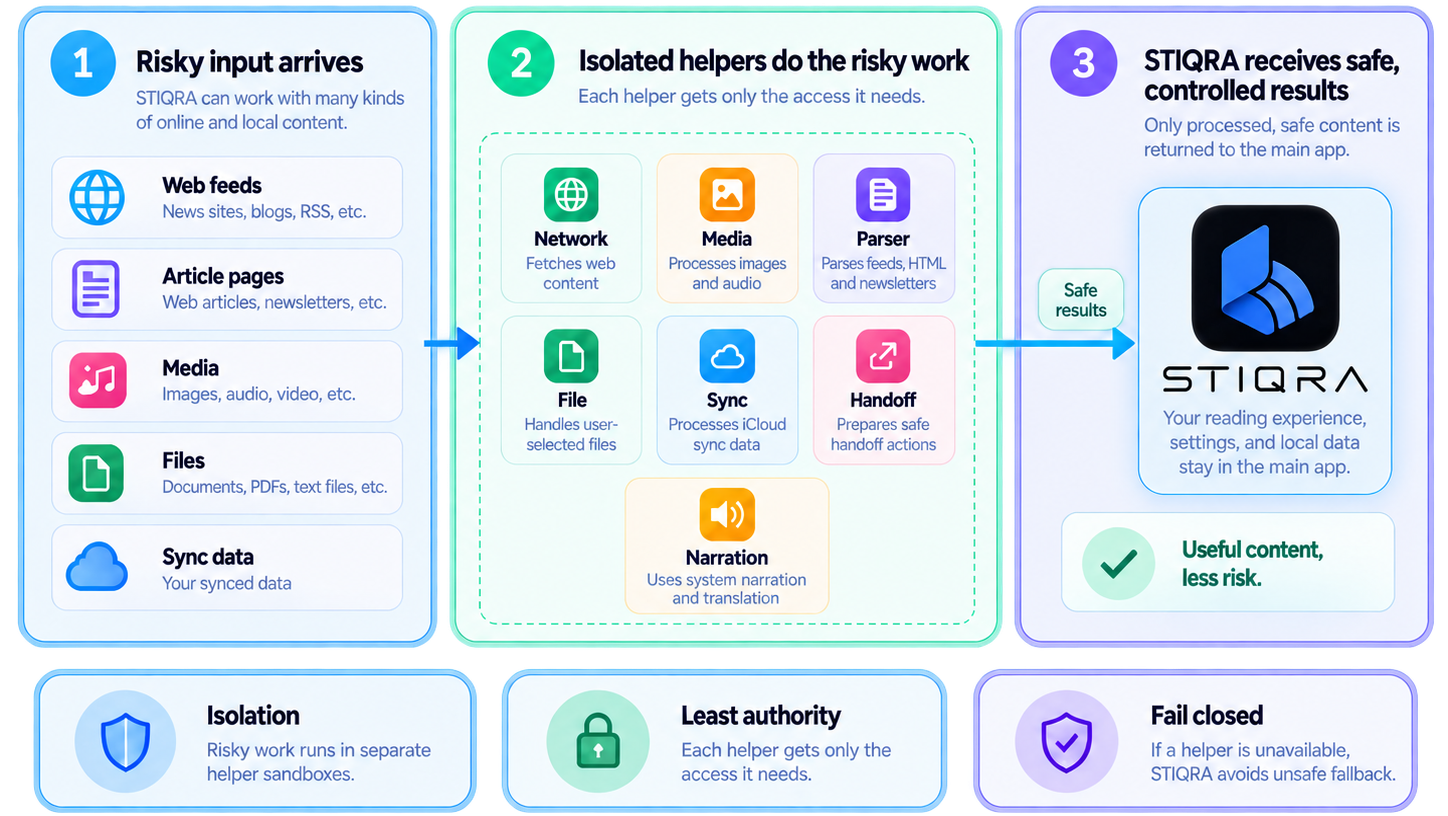
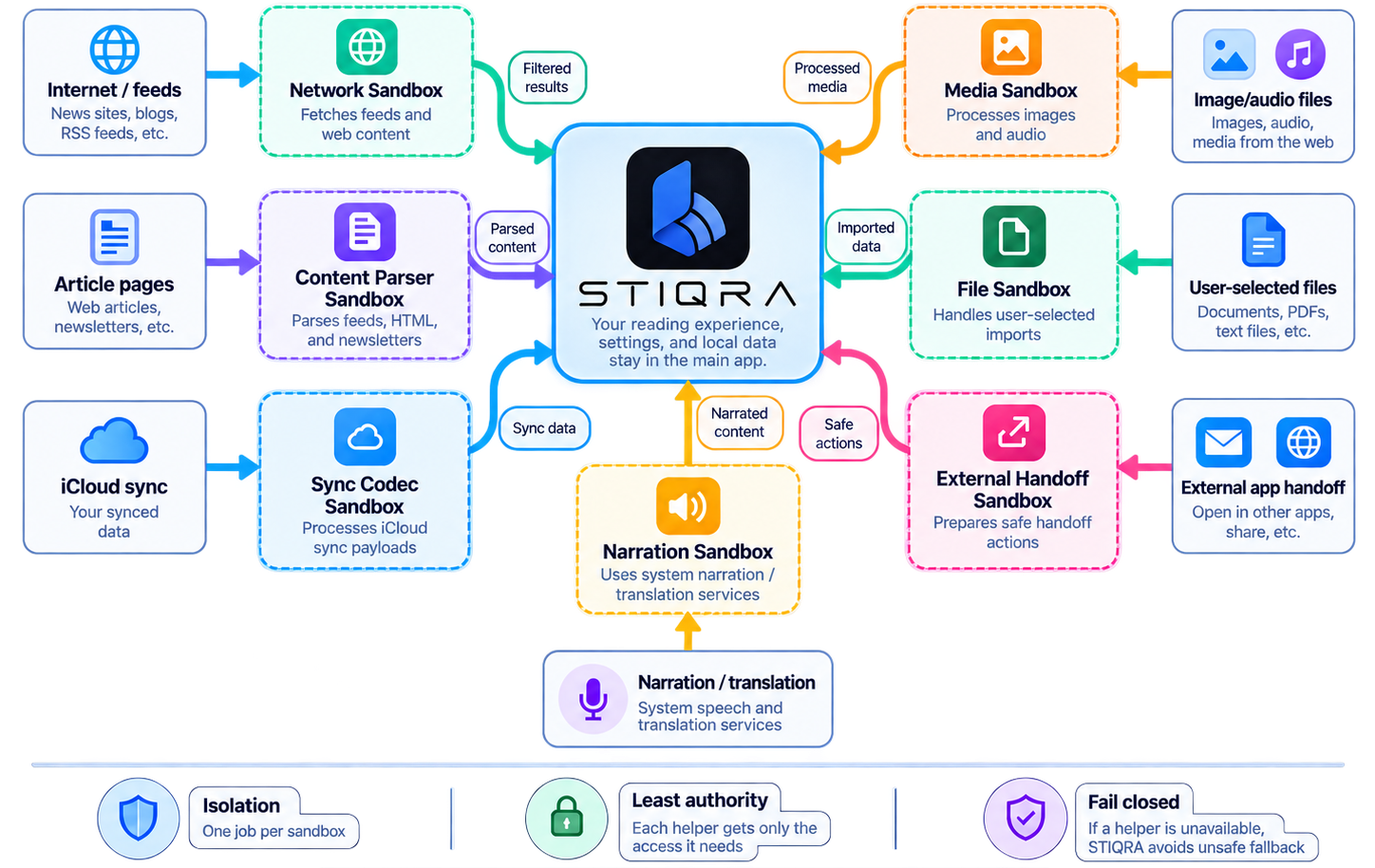
STIQRA moves work involving external content, files and media into isolated helpers (sandboxes) so the main application receives controlled results while local reading data and settings remain in the app.

On macOS STIQRA uses XPC services. On supported iOS versions it uses isolated helper extensions.

Validate before use

Feeds, images, files, URLs, clipboard data, imports, generated text, and handoffs pass workflow-specific limits and checks before use.

Keep display inert

Untrusted content is presented through bounded native paths that avoid running publisher scripts or triggering hidden remote loads as a display side effect.

Keep the dependency surface inspectable

The reviewed shipping code contains no third-party code packages or SDKs and uses XMAKYNA-owned Swift code with Apple platform frameworks. This reduces dependency and software supply-chain surface, but it does not eliminate runtime trust boundaries or prove the application secure.

Test boundary changes

Tests, guard scripts, build verification, and boundary checks cover important ingress and handoff rules and are updated when those paths change.

Privacy

What stays in STIQRA, and what leaves it.

The article library and reading state live in the app data area. Fetching a feed or image contacts an approved source. Opening links in a browser, sharing, clipboard actions, exports, translation, reports, audio and other optional workflows cross explicit trust boundaries based on the chosen action.

App data

Articles, read and saved state, archive state, filters, source settings, and metrics are stored in the app data area.

Feed and image requests

STIQRA contacts the exact public HTTPS origins the user approves. Normal reading does not require an XMAKYNA feed proxy.

External actions

Opening a browser, sharing, copying, exporting, translating, generating a report, or handing work to another app crosses into an external workflow with its own trust boundary.

Code and service boundaries

Third-party feed and image hosts, Apple's CloudKit/iCloud service when enabled, and explicit external handoffs are runtime interactions, not software packages bundled into STIQRA. The app's shipping code is XMAKYNA-owned Swift code using Apple platform frameworks.

Use cases

A reader for daily monitoring and deeper research.

Daily source review

Read across selected feeds, filter routine items, and keep saved or unfinished work separate.

Research a topic

Use search, tracking, source views, saved articles and related coverage to keep context attached to its sources.

Listen instead of read

Use podcasts and text-to-audio workflows when audio is the better way to consume the material.

Diagnose a source

Use source statistics to understand failures, latency and other problems observed during normal refresh work.